_edited.png)
How Much Does Rabbit Manure Cost — and Is It Worth Buying?
Updated: Apr 27
When people compare rabbit manure cost, they usually focus on price per pound. But that’s often the wrong metric.
Fertilizer cost isn’t just what you pay — it’s what you handle, store, compost, and fix when it goes wrong.
Chicken manure can burn plants. Raw manure needs composting. Bulk compost is cheap, but you’re moving a lot of material for diluted results.
If you already have a system for that, it can make sense. If you don’t, it becomes another job.
That’s where rabbit manure stands out.

What it changes
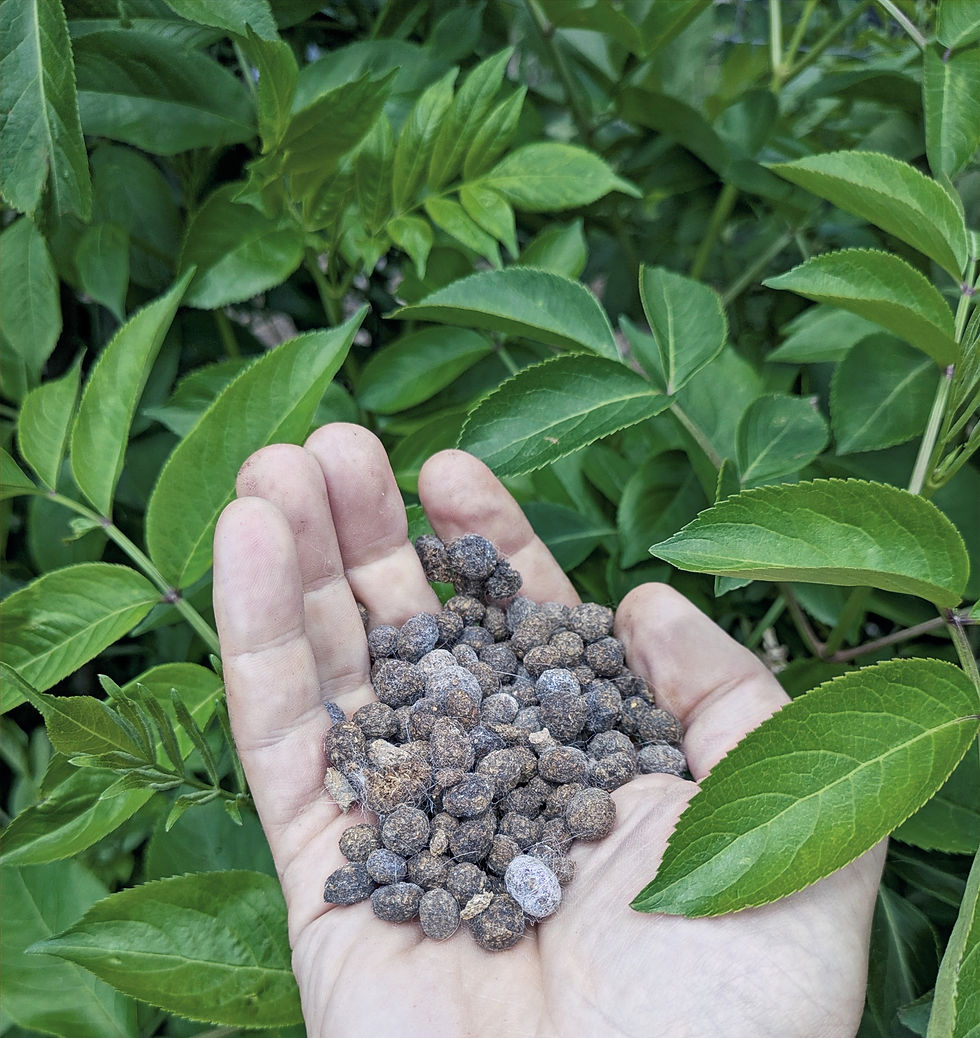
Rabbit manure is applied directly. No composting, no waiting, no dilution, no burn management.
You measure it out, work it lightly into the soil, water it in, and you're done.
That doesn't make it better in every situation. It just removes the steps that tend to create friction in smaller gardens.
What that looks like in practice
Take a standard raised bed.
A 10 lb bag covers roughly 80–100 square feet at the standard application rate — ¼ cup per square foot. That's two 4×10 beds, fertilized in one pass. No prep, no staging, no follow-up to correct for over-application. You apply it and move on.

What rabbit manure costs
Rabbit manure is priced as a specialty input, not a commodity fertilizer.
When you run the math on coverage, the cost per square foot is higher than bulk compost. That’s not a surprise, and it’s not the argument. The benefit of rabbit manure is not the price tag, but ease-of-use.
Bulk compost and bagged cow manure are designed to be applied in volume. This isn’t. It’s applied in measured amounts, where you actually need it.
As bag size increases, the cost per square foot comes down. It doesn’t match bulk inputs, and it isn’t meant to.
Where the price comes from
Raw rabbit manure can be free. It's also wet, mixed with bedding, and inconsistent from one source to the next.
The bagged version is dried to a stable moisture level, screened, and consistent. It stores cleanly, spreads evenly, and performs predictably. Our manure is lab-analyzed at 2.01% nitrogen, 2.27% phosphorus, and 1.28% potassium — that's what's actually in the bag, not a chart estimate.
You're not paying for packaging. You're paying to remove variability.
Where it doesn't make sense
If you're covering large areas, the cost doesn't work. Bulk composted manure wins on scale.
If you already run a compost system, you've absorbed the handling cost. Raw inputs make more sense there.
If you need a fast nitrogen push, chicken manure is more aggressive. Rabbit manure feeds steadily — it doesn't spike.
None of those are edge cases. They're common situations where rabbit manure is the wrong choice.
Where it does
Small beds, containers, and gardens without a compost system. Situations where the limiting factor isn't raw material, but how cleanly you can apply fertilizer without creating another problem.
Rabbit manure reduces that to one step: apply and water.
There's also the burn question. Chicken manure applied wrong can damage plants. Rabbit manure applied wrong usually just under performs. That margin for error matters more than it seems.
The honest bottom line
Rabbit manure isn't cheap. Yet it's one of the simplest fertilizers to use.
If your priority is lowest cost per pound, buy composted cow manure.
If your priority is applying fertilizer cleanly, predictably, and without prep in a small-to-medium garden, rabbit manure holds up.
That's the tradeoff. You know which situation you're in.
Shop rabbit manure fertilizer → — available in ½ lb to 25 lb bags, free shipping.
For application rates by crop and garden type, see the application guide. For a direct comparison against other manure types, see rabbit manure vs. other manures.


